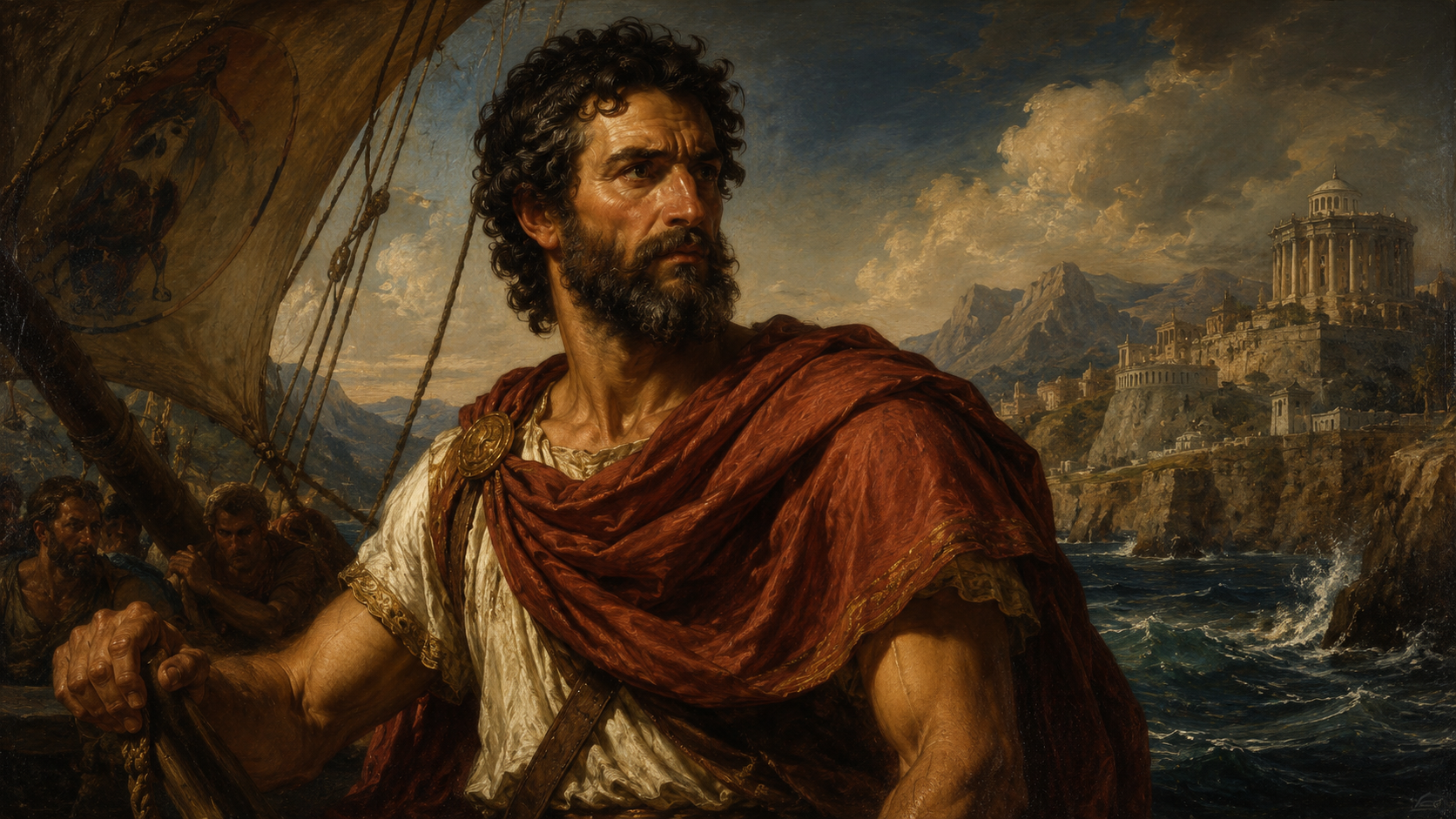
A Hero Returns to the Spotlight
With Christopher Nolan preparing to bring The Odyssey to the big screen, one of mythology’s most fascinating figures is about to find himself back in front of a global audience. It is difficult to imagine a better director for the job. Nolan has made a career out of stories involving fractured timelines, morally complicated protagonists, and the unsettling idea that intelligence can be both a gift and a burden. That happens to describe Odysseus rather well.
Yet for all the excitement surrounding the film, Odysseus has never really needed Hollywood to remain relevant. His story has survived wars, empires, religious upheaval, cultural revolutions, and several thousand years of changing literary tastes. There is a reason for that. Odysseus is not merely another monster-slaying hero from the ancient world. He is one of the earliest fictional characters who feels genuinely, frustratingly, recognisably human.
He is brave, but not fearless. He is intelligent, but not always wise. He is loyal to his family, but fully capable of deception. He can outwit kings, monsters, and even gods, yet many of his worst disasters are entirely self-inflicted. Unlike heroes such as Achilles, who often feel larger than life, Odysseus has always felt closer to life itself.
That may be why readers keep returning to him.
According to Encyclopaedia Britannica’s overview of The Odyssey, Homer’s Odyssey remains one of the defining works of Western literature, not simply because of its adventure or mythology, but because it explores themes of identity, memory, grief, temptation, leadership, and home. Strip away the cyclopes and sea monsters, and at its heart, The Odyssey is about a man trying to find his way back to the life he left behind, only to discover that both he and that life have changed.
The King of a Small Island Who Outsmarted Bigger Men
Odysseus ruled Ithaca, a rugged island off the western coast of mainland Greece. Ithaca was not Sparta. It was not Mycenae. It did not possess vast armies or immense wealth. In many ways, it was the sort of kingdom that might easily have been overlooked in the power politics of the Late Bronze Age.
Its king, however, was not easy to overlook.
Ancient Greek writers consistently describe Odysseus as polymetis, a term usually translated as “of many devices” or “of many counsels.” The phrase appears throughout Homer’s epics, and it tells us something important. Odysseus was not celebrated because he could overpower everyone in the room. He was celebrated because he usually understood the room better than anyone else in it.
According to the Theoi Project’s compilation of classical sources on Odysseus, his reputation for cunning was so deeply ingrained in Greek tradition that later writers began attaching increasingly elaborate stories to his youth and ancestry. Some even claimed he may have been descended from Sisyphus, the eternal trickster of the underworld. Whether anyone truly believed that is difficult to say, but it reflects how the Greeks saw him. Odysseus did not simply solve problems. He seemed to be wired differently from other heroes.
One of the earliest examples of this comes before the Trojan War had even begun. When the Greek kings were summoned to honour their oath and join the expedition to Troy, Odysseus decided he would rather stay home with his wife Penelope and their newborn son Telemachus. So he attempted something few heroes would have considered.
He pretended to be insane.
Ancient accounts preserved in Apollodorus at the Perseus Digital Library describe how he yoked mismatched animals to a plough and sowed salt across his fields instead of seed, hoping to convince everyone that he had lost his mind. It nearly worked. Only when the recruiter Palamedes placed infant Telemachus in front of the plough did Odysseus reveal himself by swerving to protect his son.
It is a wonderful story because it tells you almost everything about him before he ever picks up a sword. He is clever enough to try to outmanoeuvre destiny, but human enough to fail the moment his family is involved.
The Trojan War and the Birth of a Legend
The Trojan War transformed Odysseus from a regional king into a legend. While Homer’s Iliad focuses more heavily on Achilles and the brutal final stages of the conflict, Odysseus plays a critical role throughout. He acts as a diplomat, strategist, negotiator, and occasionally as the only person capable of speaking sense to men whose egos were roughly the size of their armies.
He was not physically weak. Homer makes it clear that Odysseus was a capable warrior, and in several passages he proves himself in combat. But even in war, his greatest weapon was his mind.
That became immortalised in the story of the Trojan Horse.
Interestingly, many casual readers assume the horse is a central event in the Iliad, but it is not described in detail there. Much of what people know about it comes from later sources such as Virgil’s Aeneid at the Perseus Digital Library. According to the tradition, after ten years of siege warfare, Odysseus proposed constructing an enormous wooden horse and hiding Greek soldiers inside it. The rest of the army would pretend to retreat, leaving the horse as a supposed religious offering.
The Trojans, believing they had finally won, brought it inside their city walls.
One of the more overlooked details in this story is that several Trojans actually warned against accepting the horse. The priest Laocoön famously urged his countrymen to be suspicious, giving us the line often translated as “Beware of Greeks bearing gifts.” He was ignored.
Odysseus did not win Troy by overpowering it. He won by understanding how pride, celebration, and the desire to believe good news can blind even intelligent people. Three thousand years later, that feels less like mythology and more like a timeless lesson in human psychology.
What Most People Miss About The Odyssey
By the time Homer’s Odyssey begins, the war is over, Troy has fallen, and Odysseus has already spent years trying to get home. What many modern retellings gloss over is just how emotionally worn down he is by this point.
When Homer first introduces him in the poem, Odysseus is not battling monsters or commanding armies. He is sitting alone on the island of Calypso, staring out at the sea and weeping.
It is a surprisingly intimate image for such an ancient text. This is not the triumphant hero returning from war in polished armour. This is a man who has seen too much, lost too many friends, and begun to wonder whether home still exists as he remembers it.
Scholars at Oxford’s Faculty of Classics often point to Odysseus as one of literature’s earliest psychologically complex protagonists. His struggles are not purely physical. Much of his journey is internal. He is constantly forced to decide what kind of man he wants to be when survival and morality stop pointing in the same direction.
That tension appears repeatedly throughout his adventures.
The Cyclops Was Not His Greatest Mistake
Odysseus’s encounter with Polyphemus, the one-eyed cyclops, is perhaps the most famous episode in all of Greek mythology. Trapped in a cave while the giant devours his crew, Odysseus comes up with one of the greatest acts of improvisation in literary history. He introduces himself as “Nobody,” blinds the cyclops with a sharpened stake, and escapes beneath the bellies of sheep. The plan is brilliant. The problem comes afterward.
As his ship sails away, Odysseus cannot resist revealing his real name to the cyclops, largely because he wants credit for his own genius. Polyphemus then calls upon his father, Poseidon, to curse Odysseus’s journey.
That moment is often taught as a story about cleverness defeating strength. It is equally a story about ego undoing intelligence. Odysseus solves the immediate problem, then creates a far larger one because he wants recognition. That is a very human mistake. It is also not his only one.
Surprising Facts About Odysseus That Rarely Make It Into Modern Retellings
One of the more fascinating details in Homer’s poem is that Odysseus is not always honest, even when honesty would seem easier. In fact, by some scholarly counts, he tells more deliberate lies in The Odyssey than any other major Greek hero. He invents false identities, fictional hometowns, imaginary family histories, and elaborate cover stories, often with astonishing speed. When he finally returns to Ithaca, he even lies to his own servants before revealing who he really is. Some literary scholars have argued that Odysseus is one of the earliest characters in Western literature who understands that controlling the story can be just as powerful as controlling the battlefield.
Another rarely discussed detail concerns his famous scar. In one of Homer’s most remarkable narrative flashbacks, Odysseus is recognised not by his voice, clothing, or face, but by a scar on his leg. The scar came from a boar hunt in his youth. Homer then pauses the main story entirely to recount the full backstory of how he got it. This may seem like a small detail, but many classicists point to it as one of the earliest examples of non-linear storytelling in literature. Long before modern cinema began playing with timelines, Homer was already doing it.
Perhaps the strangest lesser-known prophecy involving Odysseus comes from his meeting with Tiresias in the underworld. Tiresias tells him that even after he reaches Ithaca and reclaims his throne, his journey is not truly over. He must eventually walk inland carrying an oar until he reaches people who have never seen the sea and mistake it for a farming tool. Only then will his debt to Poseidon be settled.
Most modern adaptations leave that part out entirely, probably because it complicates the happy ending. But Greek myths rarely end with clean emotional closure. They tend to leave a little sand in your sandals.
The Return Home and the Brutality of Justice
When Odysseus finally reaches Ithaca after twenty years, he does not announce himself with trumpets or demand immediate recognition. Instead, he disguises himself as a beggar and quietly observes his own household.
It is a deeply revealing choice. Even after surviving monsters, sorceresses, storms, shipwrecks, and divine curses, Odysseus still trusts observation more than appearances.
His wife Penelope has spent years resisting pressure to remarry, famously weaving and then secretly unravelling a funeral shroud to delay the suitors who have overrun the palace. His son Telemachus has grown into adulthood in his absence. His kingdom, though still standing, is teetering on the edge of collapse.
What follows is one of the bloodiest homecomings in ancient literature. With Telemachus at his side, Odysseus strings his bow, reveals his identity, and kills every suitor who has abused his hospitality.
Modern readers sometimes find this ending shocking. Ancient audiences would have seen something different. In Greek culture, hospitality was sacred. These men were not simply romantic rivals. They were violators of social order, political opportunists, and symbols of a kingdom left vulnerable.
Odysseus is not merely taking revenge. He is restoring the world he left behind.
Why Odysseus Still Feels Modern
What makes Odysseus endure is not that he always makes the right decisions. He often does not. He lies when truth might suffice. He boasts when silence would be safer. He can be arrogant, manipulative, and maddeningly self-confident. But he learns, he adapts, and he survives.
According to the Metropolitan Museum of Art’s essays on Ancient Greece, the heroes of the Mycenaean world were often expected to be warriors, diplomats, sailors, administrators, and storytellers all at once. In that sense, Odysseus may actually be one of the most historically grounded heroes in Greek mythology.
He is not the strongest man in the ancient world. He may not even be the most noble. But he is the one who understood, long before most heroes did, that surviving a journey sometimes requires more than courage.
Three thousand years after Homer first sang of him, Odysseus remains exactly what he always was – not merely a hero, but a man who kept finding his way through impossible things.
If there’s a lesson in that for each of us, it’s that sometimes it’s fine to embark on a journey to become several different versions of yourself before you finally remember who you were all along.
Further Reading
For readers who want to dive deeper into Odysseus, Homeric Greece, and the scholarship surrounding one of mythology’s most enduring figures:
- Purchase a copy of The Iliad & The Odyssey
- Encyclopaedia Britannica: The Odyssey
- Theoi Project: Odysseus in Greek Mythology
- Perseus Digital Library: Homer’s Odyssey
- Oxford Faculty of Classics
- The Metropolitan Museum of Art: Ancient Greece
At Ancient Theory we only use trusted sources to document our articles. Such relevant sources include authentic documents, newspaper and magazine articles, established authors, or reputable websites.